Tricky Hiragana: き, さ, ち, and ら
Learn how to distinguish the tricky hiragana characters き (ki), さ (sa), ち (chi), and ら (ra) with this helpful guide. This is Part 1/6 of the Tricky Hiragana series.
When learning Hiragana, some characters can look really similar. A common point of confusion for beginners is the characters き (ki), さ (sa), ち (chi), and ら (ra).
Why do they look similar?
All these characters have some kind of horizontal line at the top, a slanted vertical line in the middle, and a curve like belly at the bottom.
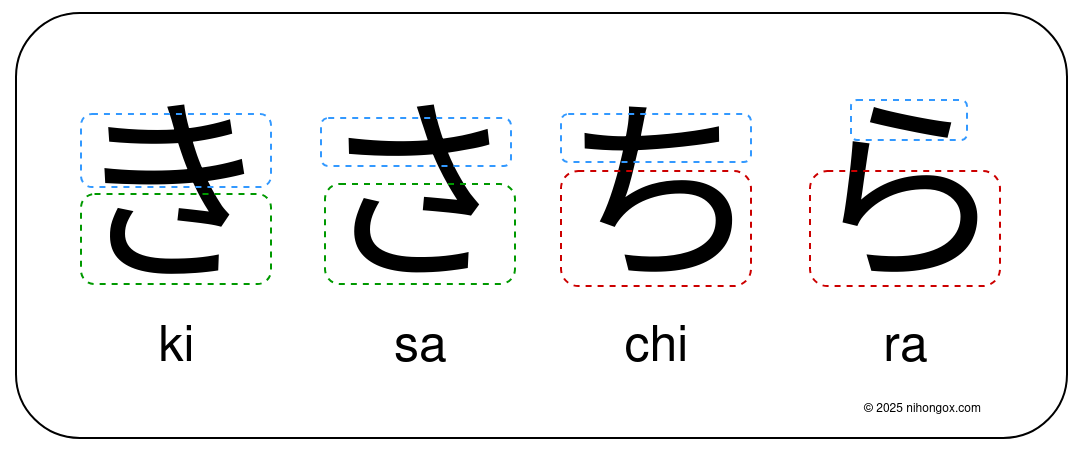
Refer to the blue dotted lines in the image guide to see how the horizontal strokes differ.
Now let’s look at each individual character and see how each is different from the others.
き (ki)
The Hiragana き (ki) is the easiest to identify from the group. It has two separate horizontal lines at the top. If you are visual, you can imagine a traditional key where the two horizontal lines are the teeth of the key.
さ (sa)
The character さ (sa) is similar to き except that it has only one horizontal line.
For both き and さ, their bellies are flat and faces the left. You can also imagine a curve of a buttock sitting down. Traditionally, they are written separately from the stem with a cut. However, some modern font would display them connected with the stem or the vertical line.
き (ki) has two horizontal lines. さ (sa) has only one horizontal line.
ち (chi)
As for the character ち (chi), it also has one straight horizontal line. Its belly or curve is more bloated and faces the right. On some fonts, it’s like the flipped image of さ (sa). As a whole, it looks like the number 5 but with the vertical and horizontal lines intersecting like a cross.
ち (chi) looks like a 5.
ら (ra)
Finally, the character ら (ra) is very similar to ち, but the top stroke is short, sometimes very short in some writing or font that it looks like a comma or a curved stroke that looks more like a dot. Its horizontal and vertical lines do not cross that makes it also looks like the number 5 but disconnected or broken at the top. Its horizontal line is too short and strokes downward.
ら (ra) looks like a broken number 5.
In summary, here’s how you can easily distinguish them:
- き (ki): Two horizontal lines.
- さ (sa): Like き, but only one horizontal line.
- ち (chi): One horizontal line and looks like a ‘5’.
- ら (ra): Short and slanted horizontal line, looks like a ‘5’ but broken.
To see how the curve strokes differ, refer to the image guide and the green dotted lines for き (ki) and さ (sa) and the red dotted lines for ち (chi) and ら (ra).
Quick Practice
Test your recognition of these characters by flipping the cards below:
Further Resources for Your Hiragana Practice
You can review the entire K, S, T, and R Hiragana sets with basic sample words and emojis using the following flash card sets:
- Hiragana K Set - Practice the full ka, ki, ku, ke, ko from this guide.
- Hiragana S Set - Review the entire sa, shi, su, se, so set.
- Hiragana T Set - Get extra practice with the ta, chi, tsu, te, to set.
- Hiragana R Set - Review the ra, ri, ru, re, ro set.
This tricky Hiragana set is also available in the Cards section at Tricky Hiragana: き, さ, ち, and ら.