Tricky Hiragana: る, ろ, そ, and お, あ, む
Study these tricky hiragana characters る (ru), ろ (ro), そ (so), お (o), む (mu), and あ (a) with interactive flash cards. This is Part 5/6 of the Tricky Hiragana series.
Welcome again to another post of our Tricky Hiragana series. On this fifth installment, we will study two groups of Hiragana characters and combine them in a single blog post. The る (ru), ろ (ro), and そ (so) are characters that all look like the number 3. Then the characters お (o), む (mu), and あ (a) have similar cross strokes at the top.
I have updated this post to include the character あ since that is also commonly confused with お.
See the previous posts of the Tricky Hiragana series. Here is Part 1, Part 2, Part 3 and Part 4
The image below is a guide to understand how the characters are similar or different by following the colored dotted lines.
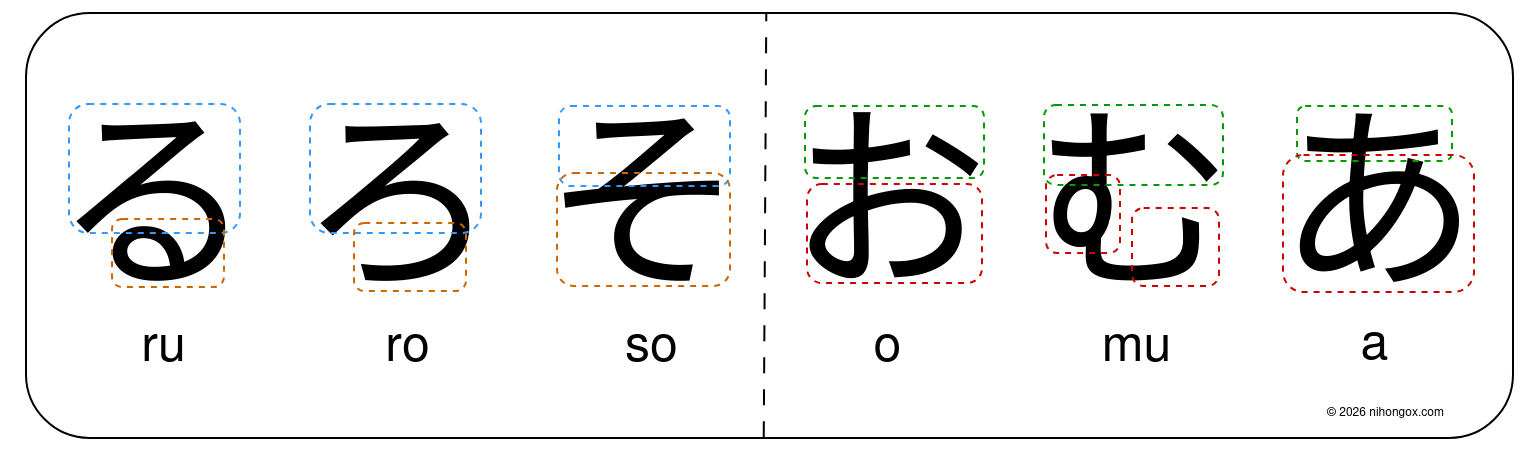
The Number 3 group of る (ru), ろ (ro), and そ (so)
The characters る (ru) and ろ (ro) both really look like the number “3”. The character そ (so) however is not exactly like a 3 but it starts with a similar Z-stroke with an opposite curve downward stroke.
To differentiate the first two characters, think of る (ru) as a number 3 with a loop at the end. Another trick to remember it is the word “loop” or “ruupu” in Japanese. Ru for ruupu. Then for ろ (ro), it is a number 3 without a loop. It ends smoothly. ろ is the one closest to the number 3 in appearance.
る (ru) is a 3 with a loop.
ろ (ro) is a 3 with no loop.
Then the character そ (so) looks more like a letter Z placed on top of a letter C. It can usually be written in a single stroke starting with the Z on top then the C stroke at the bottom.
そ (so) is a letter Z on top of a letter C.
Sometimes I would also confuse そ (so) with ぞ (zo) because I see the letter Z and pronounce it as Z instead of S. Remember that for ぞ (zo) it has the dakuten marker (゛).
Quick Practice - る, ろ, and そ
Flip the cards below and test your understanding.
Tricky お (o), む (mu) and あ (a) Characters
When learning Hiragana, we usually start with the vowels. The characters あ (a) and お (o) are the first characters that can really get us confused. Then add the む (mu) character, all three have a similar starting stroke, i.e., a cross or plus. However, they differ on how the stroke ends.
The character お (o) starts with a horizontal line that is relatively short. Then the vertical stroke cuts through it and goes down to create a small loop on the left and continues with a big curve on the right that looks like a dome. It finishes with a dot or short slash on the top right.
On the other hand, the character あ (a) can have a wider horizontal line to start. Then the vertical stroke is just a straight line. So the first two strokes basically form a cross or lower case letter t. Then the last stroke is a big curl swoop like the pretzel in other characters we discussed before in previous blogs. No dot or slash to finish it.
Finally, the character む (mu) also starts with a horizontal line then with a vertical stroke cutting through it. But as it goes down, a small loop or knot curves on the left and a big hook to the right. It also ends with a dot or short slash.
お (o) is a cross on top of a big round dome with a slash.
あ (a) is a cross with a pretzel.
む (mu) is a cross with knot, hook and slash.
Quick Practice - お, む, and あ
Flip the cards below and test your understanding.
Further Resources for Your Hiragana Practice
Review the entire R, S, M, Vowel Hiragana sets with basic sample words and emojis using the following flash card sets:
- Hiragana R Set - Review the ra, ri, ru, re, ro set.
- Hiragana S Set - Practice the sa, shi, su, se, so set.
- Hiragana M Set - Review the ma, mi, mu, me, mo set.
- Hiragana Vowel Set - Review the a, i, u, e, o set.
Practice these tricky Hiragana characters all in one flash card deck at Tricky Hiragana: る, ろ, そ, and お, あ, む.