Tricky Hiragana: つ, う, and い, り
Understand better these tricky hiragana characters つ (tsu), う (u), and い (i), り (ri) with this interactive guide. This is Part 6/6 of the Tricky Hiragana series.
We have reached the last part of our Tricky Hiragana series. In this lesson, we will examine the curve pairs つ (tsu) and う (u) and the two-stroke pair い (i) and り (ri).
See the previous posts of the Tricky Hiragana series. Here is Part 1, Part 2, Part 3, Part 4 and Part 5
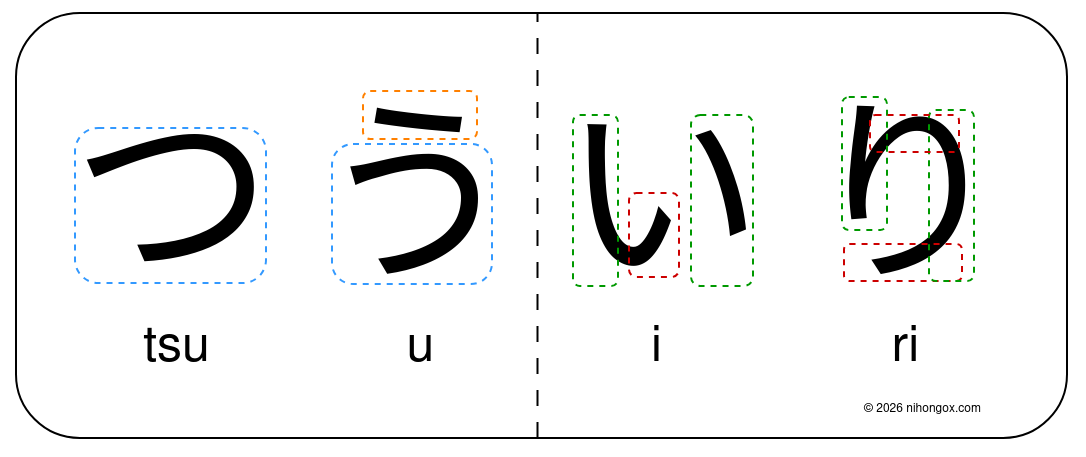
The image below is a guide to understand how these characters are similar or different by following the colored dotted lines.
The Curve Pair of つ (tsu) and う (u)
Understanding the curve pair of つ (tsu) and う (u) is quite straightforward. One is essentially the other with an extra hat on.
Refer to the orange dotted line in the image guide to see the extra hat or surfboard on う (u).
つ (tsu) is a simple character with a single curved stroke. A very common comparison to it is that it looks like a big crashing wave or a tsunami. That makes it easy to remember, tsu for tsunami.
Then the character う (u) looks almost like つ (tsu) that is slightly turned on its side and with a line on top that can be a hat or a surfboard. Perhaps think of this like a tsunami with a surfboard and you (U) are on top of the surfboard.
Refer to the blue dotted line in the image guide to see the similar tsunami strokes of つ (tsu) and う (u).
つ (tsu) is a tsunami.
う (u) is a tsunami with you on the surfboard.
Quick Practice - つ and う
Flip the cards below and test your understanding.
The Two-Stroke Pair of い (i) and り (ri)
The characters い (i) and り (ri) are confusing because they both consist of two almost vertical strokes standing side-by-side. The key difference is the length of those strokes and how they are connected.
Refer to the red dotted line in the image guide to see the differences in how the vertical lines connect in い (i) and り (ri).
In the character い (i), the stroke on the left is longer and has a little hook at the bottom then jumping up to start the next stroke. The stroke on the right is shorter. Think of a pair of parentheses ( ). Some would compare these to a pair of two eels swimming in parallel. I remember my teacher in college told us to think of an igloo where the two vertical strokes are the sides of the igloo. With either eel or igloo, the sound of “ee” will help you remember the character.
Refer to the green dotted line in the image guide to see the similar vertical strokes of い (i) and り (ri).
On the other hand, the character り (ri)’s stroke on the left is shorter. The stroke on the right is longer and curves slightly to the left at the bottom. Think of a ribbon or a river flowing down. Depending on the font, the two strokes can be connected at the top as well, which makes it similar to the letter “n” that has an extra long stroke on the right.
い (i) is like an igloo and left stroke is longer.
り (ri) is like a river and the right stroke is longer.
Quick Practice - い and り
Flip the cards below and test your understanding.
Further Resources for Your Hiragana Practice
Review the entire T, R, Vowel Hiragana sets with basic sample words and emojis using the following flash card sets:
- Hiragana T Set - Review the ta, chi, tsu, te, to set.
- Hiragana R Set - Review the ra, ri, ru, re, ro set.
- Hiragana Vowel Set - Review the a, i, u, e, o set.
Practice these tricky Hiragana characters all in one flash card deck at Tricky Hiragana: つ, う, and い, り.